
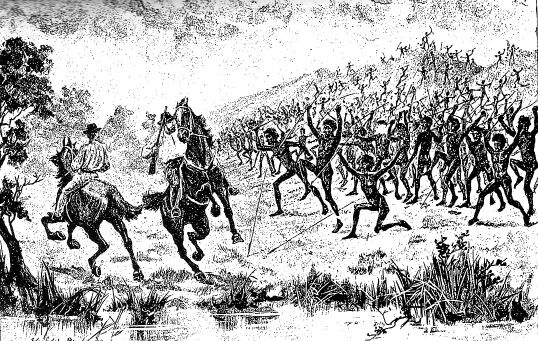
Encounter with the Natives at “the Officer”, Musgrave Range, [Central Australia, September [?] 1873. The ‘Musgrave Ranges’ straddle the boundary of today’s South Australia and the Northern Territory, extending into Western Australia]. Image from Ernest Giles, Australia Twice Traversed: The Romance of Exploration, 1880 [?], published by The University of Adelaide as an ebook, 14 December 2014
The Northern Territory of Australia was officially part of colonial New South Wales from 1825 to 1863 and was briefly called the Colony of North Australia from February to December 1846. The Northern Territory was officially part of the colony of South Australia from 1863 to 1 January 1911 when it separated from South Australia. ‘Central Australia’ is the region in the southern part of the Northern Territory. First Nations people retaliated against uninvited colonial and immigrant intruders on Country for reasons such as illegal killings, interference with and maltreatment of women and children, desecration of food and water sources, hunting grounds, and sacred sites.
The list below includes locations of some known conflicts that took place geographically in the area that we know today as the Northern Territory. Although, apart from the incident at Attack Creek in 1860, up to 1 January 1911, the locations were officially in the Northern Territory of the colony of South Australia, except for places that were located in the colony of Queensland from 12 April 1862, like Annandale Station, the vicinity of which was the site of a massacre of Aboriginal people in 1879. Additional locations and summaries of conflicts are being added to this list as new information is found.
The ‘Coniston Massacre’, a series of incidents that occurred in the Northern Territory in 1928, is often referred to as last massacre of First Nations peoples on Australian soil. However, conflicts between colonists, immigrants, and First Peoples continued beyond 1928. While it was believed that these types of conflicts ended in the Northern Territory in the 1940s, new research shows that they continued even until the 1980s. On 16 March 2022, Lorena Allam reported in The Guardian that University of Newcastle historian, Dr Robyn Smith, had discovered a massacre in Alice Springs as recently as 1981: Read more: https://www.theguardian.com/australia-news/2022/mar/16/attempted-aboriginal-massacres-took-place-as-recently-as-1981-historian-says
Main Sources
Some of the main sources of information about conflicts that happened in the Northern Territory are included in such hard copy and online publications as:
A Bastard Like Me, Charles Perkins, 1975, Ure Smith, Sydney Chapter 2, pp. 19–20. Available from the Australian Institute of Aboriginal and Torres Strait Islander Studies: https://aiatsis.gov.au/sites/default/files/e_access/book/m0063258/m0063258_a.htm, accessed 27 September 2022.
A Wild History: Life and Death on the Victoria River Frontier, Darrell Lewis, Monash University Publishing, 2012
Coniston Massacre: https://en.wikipedia.org/wiki/Coniston_massacre, Wikipedia, accessed 31 May 2023
Frontier Justice: A History of the Gulf Country to 1900, Tony Roberts, University of Queensland Press, 2005
How They Fought: Indigenous Tactics and Weaponry of Australia’s Frontier Wars, Ray Kerkhove, Boolarong Press, 2023
In the Name of the Law: William Willshire and the Policing of the Australian Frontier, Amanda Nettelbeck and Robert Foster, Wakefield Press, Kent Town, South Australia, 2007
Kaytetye Country: An Aboriginal history of the Barrow Creek area, Grace Koch, complier and editor, Harold Koch, translations, Institute for Aboriginal Development Publications, Alice Springs, Northern Territory, 1993
Mataranka and the Daly, Two Studies in the History of Settlement in the Northern Territory, Jane Gleeson and Michaela Richards, Australian National University, North Australia Research Unit Monograph, Darwin, 1985, available in the National Library of Australia and at the Australian Institute of Aboriginal and Torres Strait Islander Studies, Canberra.
‘Northern and Western Australia’ in The Australian Frontier Wars 1788–1838, John Connor, University of New South Wales Press, 2002, pp. 68–83
Remembering the Coniston Massacre, Teresa McCarthy, Northern Territory Library Anmatyerr community history project, 2008, now at Territory Stories: https://territorystories.nt.gov.au/10070/213508/0
The Black War in Arnhem Land: Missionaries and the Yolgnu 1908–1940, Mickey Dewar, The Australian National University, North Australia Research Unit, reprinted in 1995, available at: https://openresearch-repository.anu.edu.au/bitstream/1885/49270/1/TheblackWarinArnhemLand2.pdf
Yijarni: True Stories from Gurindji Country, Erika Charola and Felicity Meakins eds, Australian Institute of Aboriginal and Torres Strait Islander Studies, Canberra, 2016
For more references see the Bibliography, Books and Journal Articles. Also check Resources in the main menu. Scroll down to Databases, Films and Television, Memorials and Monuments, Videos, and Warriors. The News page includes posts about some related First Nations issues.
Map: To see a map of some of the known conflicts that happened in the Northern Territory, please follow this link. All coordinates are approximate. Summaries of what happened at each place are being added gradually to the Northern Territory map as time permits.
Many thanks to readers who email information about colonial frontier conflict sites. Locations will be added to the list below as new information is found and time permits. If you know of incidents that occurred, are not included in the list below and wish to contact the author of this website, please use the form on the Contact page.
WARNING: Some of the placenames listed below are offensive and may be upsetting to some readers. Derived from geographical names registers, historic and modern-day maps and other primary and secondary sources, these placenames reflect the attitudes, racism and activities of those people who gave these places English names during the frontier period.
| Date | Location |
|---|---|
| Before 1914 | 'Blackfellows' Bones' near Mount Riddock, north of Alice Springs, NT, Massacre of Aboriginal people. The incident, that took place before 1914, included the killing of Charles Perkins' mother's close relatives and her escape from the murderers. Source: Charles Perkins's autobiography, A Bastard Like Me, Ure Smith, Sydney, 1975, p. 19 |
| 1885 | Alexandria Station, NT, First Nations people kill Benigan and Donovan. |
| 5 March 1885 | Alexandria Station, NT, First Nations people kill John Ross. |
| 1981 | Alice Springs, NT Two Aboriginal people died and 14 were admitted to hospital after unwittingly drinking from a poisoned bottle of sherry that was deliberately left near the town's John Flynn Memorial. Read more in Lorena Allam's story 'Australia's history of massacres should be no surprise, but many have to be dragged to the truth,' The Guardian, 16 March 2022: https://www.theguardian.com/australia-news/2022/mar/17/australias-history-of-massacres-should-be-no-surprise-but-many-have-to-be-dragged-to-the-truth |
| August 1884 | Angkwerl (Anna’s Reservoir), Aileron Station, NT |
| 19 May 1937 | Anningie Station, 50 kms north of Ti-Tree, NT |
| 25 June 1860 | Attack Creek (Goaranalki), Stuart Highway, 74 kms north of Tennant Creek, NT Warramunga warriors attacked John McDouall Stuart and party. No known deaths or injuries but party forced to leave. |
| 1892 | Auvergne Station, NT, Aboriginal man, Charlie Flanagan, murders Sam Croker, who is notorious for his ill-treatment of First Nations people. |
| 1918 | Auvergne Station, NT, murder of Alexander McDonald |
| 1874 | Barrow Creek Station, (Thankenharenge or Barrow Creek) NT Warriors hold the station under siege for about five days, blocking all possible exits. Relief of European occupants prevented when First Nations scouts attack a telegraph line party 32 kms from the station. Source: Gordon Reid, 1990, A Picnic with the Natives, Carlton: Melbourne University Press, p. 45 cited in Ray Kerkhove, How They Fought: Indigenous Tactics and Weaponry of Australia's Frontier Wars, Booralong Press, 2023, pp. 118, 120 Grace Koch, complier and editor and Harold Koch, translations, Kaytetye Country: An Aboriginal History of the Barrow Creek Area, Institute for Aboriginal Development, Alice Springs, NT, 1993 |
| Nineteenth and twentieth centuries–Dates of conflicts, numbers of deaths and injuries unknown | Bauhinia Downs, NT |
| June 1894 | Black Gin Creek, NT |
| November 1933 | Blue Mud Bay area, Arnhem Land, NT |
| 1803 | Blue Mud Bay, Arnhem Land, NT Captain Matthew Flinders lands twice in Arnhem Land as part for circumnavigation of the Australian continent. The first landing is without incident. During the second landing at Blue Mud Bay on 4 November 1803, one of the crew of the Investigator is speared four times. Two First Nations men are shot dead. Example of source: Wikipedia entry on Matthew Flinders. |
| 10 December 1894 | Bowgan Waterhole outstation, Cresswell Downs Station, NT, Thomas Perry killed by Aboriginal people. |
| Between 1894 and 1904 | Bradshaw Station, NT |
| 18 October 1886 | Broadmere outstation, NT, First Nations people kill Edward Lenehan. |
| c. January 1889 | Brunette Downs Station, NT, Fight between Robert Hamilton and an unnamed Aboriginal man. |
| 1884 | Burrundie, NT, 200 kms south of Darwin, NT, Woolgonga tragedy |
| 14 Nov 1803 | Caledon Bay, NT Flinders takes 14-year old Woga captive, ties him to a tree, in an attempt to coerce local people to return an axe. Flinders releases the boy after a day. The axe is not returned. |
| c. 1880s | Calvert Downs (at Gabugabuna), NT, Aboriginal people shot. Reasons for killings not recorded. |
| c. 1880s | Calvert Downs (at Mawurra Cave), NT, Aboriginal people killed. Reasons for killings not recorded. |
| c. 1880s | Calvert Downs (at Waningirrinyi Waterhole), NT, Aboriginal people killed. Reasons for killings not recorded. Bones of dead recovered and placed in a cave. |
| 1880s | Calvert Hills, NT |
| 25 September 1928 | Circle Well, Hanson River, NT (a Coniston Massacre killing site) |
| 8 September 1894 | Cliffdale Creek, NT, John Clarke killed by Aboriginal people. |
| 1890s | Coanjula Creek, near the upper Nicholson River, NT |
| c. 1882 | Coast Track (now called Savannah Way) at Calvert River, NT, Aboriginal people killed after an attack on Dick Moore's camp. |
| 1883 | Coast Track (now called Savannah Way) at Frasers Creek, NT, Aboriginal people killed in punitive expedition after killing of Fraser and his First Nations assistant. |
| 2 December 1877 | Coast Track (now called Savannah Way), near Nicholson River, NT, Murder of William Batten |
| 1883 | Coast Track (now called the Savannah Way) at Skeleton Creek, NT, Aboriginal people killed in punitive expedition after Charley Willis's horses speared. |
| 1878 | Coast Track (now called the Savannah Way) near Limmen Bight River, NT, Aboriginal people killed in punitive expedition after Travers' murder. |
| April 1888 | Coast Track (now called the Savannah Way), 8 kms east of the Calvert River, NT, Unnamed German man killed by Aboriginal people. |
| 1872 | Coast Track (now called the Savannah Way), Gulf Country, NT Multiple killings of Aboriginal people |
| 20 May 1880 | Coast Track (now called the Savannah Way), Limmen Bight River, NT, Murder of John Barry |
| 1877 | Coast Track (now called the Savannah Way), near Nicholson River, NT Punitive expeditions after William Batten's murder |
| 2 June 1881 | Coast Track (now called the Savannah Way), Rosie Creek, NT, Patrick McNamara killed by Aboriginal people. |
| 1928 | Cockatoo Spring, NT |
| 14 August–18 October 1928 | Coniston Station and vicinity, NT -- the 'Coniston Massacre' was not one incident, but a series of conflicts between colonists and First Nations people that took place over a wide area of Central Australia, on and around Coniston Station and nearby stations, in 1928. Among the known locations of killings that occurred are: Jarrarlyku (Curlew Waterhole), Kunajarrayi (Dingo Waterhole), Tomahawk Waterhole, Janangpa (Boomerang Waterhole), Warlawurrukurlangu, Warranyirrtipa, Patilirri (Tipinba), Kurlurlu, Circle Well, Athimpelengkwe or Thimplengkwe (Baxter's Well), Yungarnti, Warlukurlangu, Liirlpari (Whitestone), Kakutu (Cockatoo Creek), Ngarningiri, Rrkwer or Yurrkuru (Brooks Soak), Mawu, and west of Yuendemu. (Individual entries, where dates are known, appear below). In his autobiography, A Bastard Like Me, Ure Smith, Sydney, 1975, pp. 19–20, Charles Perkins mentions the incident at Brooks Soak (Rrkwer or Yurrkuru), about 370 kilometres north-west of Alice Springs. A Wikipedia entry on the "Coniston Massacre": https://en.wikipedia.org/wiki/Coniston_massacre, accessed 31 May 2023, refers to various versions of some of these incidents. Gibson et al in 'Memory-lines: Ethnographies of colonial violence in Central Australia,' provide more detail in Chapter 3 of Cameo Dallewy and Ashley Barnwell eds, Memory in Place: locating colonial histories and commemoration, ANU Press, 2023 |
| Cooningheera Waterhole, NT | |
| 1877 | Corella Downs and vicinity, NT, Aboriginal people killed in a punitive expedition after murder of Fred Jeffries and his Aboriginal assistant. |
| 1892 | Corella Downs Station (at Corella Creek), NT, Aboriginal people killed in punitive expedition, led by Constable Smith, after murders of Clark and Deloitte. |
| 1892 | Corella Downs Station (at Corella Creek), NT |
| 1887 | Corella Downs Station, NT, Frederick Jeffries killed by Aboriginal people. |
| 31 December 1888 | Corella Downs Station, NT |
| 1892? | Cresswell Downs Station (at Kiana Rockhole), NT, Another possible punitive expedition, led by Constable Smith after murders of Clark and Deloitte. |
| 1892 | Cresswell Downs Station (at Puzzle Creek south), NT, Aboriginal people killed in punitive expedition, led by Constable Smith, after murders of Clark and Deloitte. |
| 30 January 1892 | Cresswell Downs Station, NT, Murders of Clark and Deloitte at Bowgan Waterhole outstation. |
| 1896–97 | Cresswell Downs, NT |
| Cuppa Waterhole, NT | |
| September 1884 | Daly River, NT, 'Coppermine massacre' |
| 1884 | Daly River, NT |
| Dangeri Waterhole, NT | |
| 1934 | Darwin, NT: Dhakiyarr Wirrpanda from Arnhem Land possibly murdered after release from Fannie Bay Gaol on 9 November 1934. Following calls from his descendants and an ABC investigation, in late 2025, the Northern Territory Police re-open its investigation of Dhakiyarr's strange disappearance. It is more than 90 years since he did not make it home to his Yolngu outstation, Dhuruputjpi. Read more in ABC journalist Jason Walls's stories dated 28 September and 9 September 2025: https://www.abc.net.au/news/2025-09-28/nt-missing-yolngu-man-cold-case-police-killing-confession/105581636 and https://www.abc.net.au/news/2025-12-09/nt-police-restarts-investigation-into-yolngu-leader/106116104, accessed 10 December 2025. |
| 24 September 1928 | Dingo Hole, Hanson River, Broadmeadows Station, NT |
| 26 September 1928 | Dingo Hole, Hanson River, NT |
| Donor's Hill Massacre, NT | |
| 1878 | Douglas River, north-west of Pine Creek, NT |
| 1886 | Dunganminnie Spring, NT |
| 1890s | East Baines River, NT |
| 1882 | Elsey Station, near Strangways River, NT, Aboriginal people killed in punitive expedition after Campbell murder. |
| 16 June 1882 | Elsey Station, NT, First Nations people murder Duncan Campbell. Punitive expedition following Campbell death results in Aboriginal deaths. |
| 1885 | Elsey Station, NT Another conflict between pastoralists and Aboriginal people at Elsey Station. |
| 1915–16 | Elsey Station, NT More conflict between pastoralists and Aboriginal people at Elsey Station. |
| 1880s–90s | Florida Station, Arnhem Land, NT |
| September 1883 | Frasers Creek, NT, Murder of John Fraser and unnamed Aboriginal assistant |
| c. 1910 | Gaargarn (Gan Gan) inland from Blue Mud Bay, Yolngu country, Arnhem Land, NT |
| 1890s? | Ganjarinjarri, upper Robinson River, NT |
| Granada, NT | |
| 1883–1920 | Gurindji Country Horse Springs Janpa Jikirrijja (Campbell Springs) Jutamiliny (Swan Yard) Jurlakkula (Nero Yard) Kumanturru (Coomanderoo) Kurturtu Malapa (Old Limbunya Homestead) Ngangi Ngurriya (Midnight) Piyirriri (Farquharson Gap) Seale Yard Waniyi Wirrilu (Blackfella Creek) Wulupu (Hooker Creek) Yurruj (Burtawurta) |
| c. 15 December 1928 | Hatches Creek, NT, After an exchange of words, Harry Henty attempts to shoot Willaberta Jack at his hut. While trying to protect his wife, Lizzie, Willaberta Jack shoots Henty dead. Willaberta Jack is arrested and tried for murder. On 31 July 1929, the Supreme Court of Central Australia, sitting in Darwin, acquits Willaberta Jack, giving a verdict of 'justifiable homicide'. This verdict was unusual, as In earlier times Aboriginal men tried for murdering colonists often went to the gallows, whether they were guilty or not. Willaberta Jack's trial was reported in the Northern Standard, on Friday 2 August 1929, p. 5. This incident was the inspiration for award-winning director, Warwick Thornton's film, Sweet Country, released in Australia on 25 January 2018. A Kaytetye version of why Willaberta Jack killed Henty explains that under Aboriginal law, Willaberta Jack was justified in killing the man who deceptively stole his wife and kept her for domestic chores and sexual relations. Peter Horsetailer's recounting of the Kaytetye history of events in the Barrow Creek area is in Grace Koch and Harold Koch, Kaytetye Country, An Aboriginal history of the Barrow Creek area, Institute for Aboriginal Development, Alice Springs, NT, 1993. pp. 41–45. |
| Hodgson Downs (at Angus Spring), NT | |
| 1903 | Hodgson Downs (at Bailey Creek), NT |
| Hodgson Downs (at Buffalo Hole), NT | |
| Hodgson Downs (at Indi Indi Spring), NT | |
| Hodgson Downs (at Mason Gorge), NT | |
| Hodgson Downs (at Sandy Lagoon), NT | |
| 1880s–90s | Hodgson Downs, NT |
| Horse Springs, NT (Gurindji Country)* | |
| c. 1875 | Irpmankara massacre, NT |
| 1896–97 | Irringa on Creswell Creek, NT |
| 1889 | Jampawurru (Red Lily Spring or Mud Spring), NT (Gurindji Country)--Gordon Buchanan, Ferguson, Barry and an Aboriginal tracker named George, encounter seven or eight Aboriginal men. In the ensuing battle the Aboriginal men are killed. |
| 27 August 1928 | Janangpa (Boomerang Waterhole), Yarlalinji (Lander River), Broadmeadows Station, NT (a Coniston Massacre killing site) |
| Janpa, NT (Gurindji Country)* | |
| January 1897 | Jasper Gorge, Victoria River, NT |
| Jikirrijja (Campbell Springs), NT (Gurindji Country)* | |
| 1882 | Jinparrak (Old Wave Hill Station), NT, Sam Croker shot an Aboriginal man in the back for trying to take a bucket and some billies. |
| Jurlakkula (Nero Yard), NT (Gurindji Country)*, Colonists killed Gurindji. They later speared and killed a kartiya (white man). | |
| Jutamiliny (Swan Yard), NT (Gurindji Country)* | |
| 22 Aug 1928 | Kakutu (Cockatoo Creek), north-east of Yuendemu, NT (a Coniston Massacre killing site) |
| Kalidawarra Waterhole, NT | |
| Kumanturru (Coomanderoo), NT (Gurindji Country)* | |
| Kurturtu, NT (Gurindji Country)*, Jack Beasley massacred Gurindji people who were performing a Juju ceremony. Beasley had also stolen a Gurindji man's wife, afterwards shooting her when she ran away. | |
| 1886 | Limmen Bight River Cave, NT |
| 1886 | Malakoff Creek, McArthur River station, NT |
| Malapa (Old Limbunya Homestead), NT (Gurindji Country)*, Harry Reid murdered Jangari because he beat him (Reid) up after Reid, Jack Cusack and Jack Carpenter had shot Jangala, burning his remains. | |
| 1883 | Massacre Hill, NT For an examination of Australian place names like the Northern Territory's Massacre Hill, see Robyn Smith, 'Australia would do well to have a chat about the truth of its history, and stop memorialising monsters,' The Guardian, https://www.theguardian.com/commentisfree/2024/feb/15/australia-would-do-well-to-have-a-chat-about-the-truth-of-its-history-and-stop-memorialising-monsters |
| Massacre Inlet, Gulf Country, NT | |
| Massacre Waterfall, Gulf Country, NT | |
| 7 April 1937 | McArthur River Gorge, NT |
| 1887 | McArthur River, at Amelia Spring NT, Aboriginal people killed. No reason rcorded. |
| 12 May 1888 | McArthur River, NT, Francis Marrin killed by Aboriginal people. |
| 1884 | McKinlay River, NT |
| c. 1880s | McPherson Creek (at Kawurrungkuma), NT, Old Aboriginal rainmakers among people shot. Reason(s) for shootings not recorded. |
| 1896–97 | Minyarrga on Creswell Creek, NT |
| Monkira, NT | |
| January 1941 | Mount Cavenagh Station, south of Kulgera, NT, Lullilicki killed by station overseer, Herbert Kitto. |
| c. 1900 | Mouth of Calvert River, NT |
| 16 September 1928 | Napperby Station, NT |
| 1878 | Near Daley River, NT |
| August 1885 | Near Limmen Bight River, NT, First Nations people kill James McCoy. |
| 13 December 1878 | Near Limmen Bight River, NT, murder of William Travers by Aboriginal people |
| Before 1920 | Near Ngima (Neave River Junction), NT (Gurindji Country) |
| August 1886 | Near Yulbarra, Vanderlin Island, NT, First Nations people kill Alfred Toms. |
| 1872 | Newcastle Waters area, NT Conflicts |
| Ngangi, NT (Gurindji Country)* | |
| Ngurriya (Midnight), NT (Gurindji Country)* | |
| 1873 | North of Pine Creek, NT Conflicts |
| Between 1913 and 1918 | Pewuly (Bow Hills Police Station), NT, Massacre of Gurindji people |
| Piyirriri (Farquharson Gap), NT (Gurindji Country)* | |
| 1896–97 | Radjiji, upper Nicholson River, NT |
| 1896 | Ranges west of Lawn Hill, NT, Aboriginal people killed in punitive expedition after two colonists killed. |
| 7 August 1875 | Roper Bar, near Roper River, NT, Abram Daer killed by Aboriginal people. |
| 30 June 1875 | Roper Bar, near Roper River, NT, Charles Johnston killed by Aboriginal people. |
| 1875 | Roper River (Mole Hill to mouth), NT, Punitive expeditions after Charles Johnston's murder |
| September 1893 | Rosewood, NT |
| Seale Yard, NT (Gurindji Country)* | |
| c. 1880s | Seven Emus Creek, near Manguwarruna, NT, Aboriginal people shot. Reason(s) for shootings not recorded. |
| 1928 | Six Mile Soak, NT |
| 1884 | Skeleton Creek, NT |
| 1874 | Skull Creek, 50 kms south of Barrow Creek, NT |
| c. 1924 | Tartarr (Blackfellows Knob), NT (Gurindji Country), Massacre of Gurindji people |
| 23 February 1891 | Tempe Downs Station, Finke River, NT |
| Thunderpurty Waterhole, NT | |
| 26 September 1928 | Tippinha or Tipinba (Patirlirr or Patilirri Creek), 24 kms west of Broadmeadows Station, NT (a Coniston Massacre killing site) |
| 24 September 1928 | Tomahawk Waterhole, Yarlalinji (Lander River), NT (a Coniston Massacre killing site) |
| 1877 | Valley of Springs Station near Cox River, NT, Aboriginal people killed after Bird murder. |
| c. March 1887 | Valley of Springs Station, NT, Man named Bird killed by Aboriginal people. |
| c. 1886 | Vanderlin Island and vicinity, NT, Men from the Smuggler shoot Aboriginal people. |
| 1883–1910 | Victoria River Downs, NT, Massacres of Aboriginal people |
| March 1910 | Victoria River Downs, NT, Walkirr kills WJJ (Brigalow Bill) Ward. |
| 1905 | Victoria River, NT, Bradshaw massacre |
| 26 September 1928 | Wajinpulungk, NT |
| Waniyi (near Number 2 Bore), NT (Gurindji Country)*, kartiya ambushed and killed Aboriginal people in this area more than once. | |
| 1883/84 | Warluck (Seale Gorge), NT, British pastoralists massacre Gurindji people. |
| 1899 | Wave Hill, NT |
| c. 1880s | Wearyan River, near Manangoora, NT, Aboriginal people killed while gathered for a funeral ceremony. Reason for killings not reported. |
| 23–30 August 1928 | West of Yuendemu, NT (a Coniston Massacre killing site) |
| 17 September 1932 | Western side of Caledon Bay, Arnhem Land, NT Yolgnu people kill five Japanese trepang fishermen, Tanaka, Kimishima, Shibasaki, Inamori and Higasaki, to stop the Japanese taking trepang out of Caledon Bay and from committing other offences against Aboriginal and European law. The killings may also have been in retaliation for a fight at Port Bradshaw earlier in 1932. In that encounter Japanese trepangers had fought with, and shot at, Aboriginal people. Before the killings, Kimishima had admitted to shooting at Aboriginal people seeking work on his boat. Aboriginal people also reported to missionaries and government authorities that the Japanese had kidnapped and sexually attacked Aboriginal women, assaulted and whipped Yolgnu who worked for them as divers. One Yolgnu man had trepang thrown at him, another had been dumped headfirst into trepang offal. A council of Yolgnu decided that the only way to protect their families and their trepang was to frighten the Japanese by killing some of them in accordance with Aboriginal law. |
| October 1892 | Willeroo Station, NT |
| Wirrilu (Blackfella Creek), NT (Gurindji Country)* | |
| 1897 | Wollogorang (at Baladuna Waterhole), NT |
| 1880s | Wollogorang Station (at the Pocket), NT, Aboriginal men, women and children shot in reprisal for spearing cattle. |
| June 1933 | Woodah Island, NT |
| 1896–97 | Woodawalla on Creswell Creek, NT |
| Wulupu (Hooker Creek), NT*, Gurindji survived shootings. | |
| Yurruj (Burtawurta), NT (Gurindji Country)*, Gurindji and Mudburra people shot in massacres. In one retaliation Gurindji men attacked a kartiya camp while the men were asleep, spearing a number, then burning their remains. | |
| 1905 | Near Wadeye (Port Keats), NT, Reprisal |
*Entries marked with an asterisk at the end of the table are from Gurindji historians as told in Erika Charola and Felicity Meakins eds, Yijarni: True Stories from Gurindji Country, AIATSIS, 2016. Exact dates of the incidents are not known, but massacres and conflicts occurred in Gurindji Country in the Killing Times, from c. 1882/83, when British colonists invaded Gurindji lands for pastoral pursuits, until some time in the 1920s.
© Jane Morrison 2015–2024. Updated 3 June 2022, 27 September 2022, 5-7, 28 October 2022, 7 November 2022, 31 May 2023, 4 May 2024, 27 March 2025, 21 April 2026. Compiled from the sources mentioned above and from the main Bibliography. No responsibility taken for errors in primary or secondary sources.